Accra-Kumasi Expressway: Route, interchanges, distance and key details of the 198.7km project
Accra-Kumasi Expressway: See the 198.7km route, interchanges, bridges, travel-time savings, tolling plans and key details of Ghana's major road project.

By Edem Kwame
Published Updated 6 min read
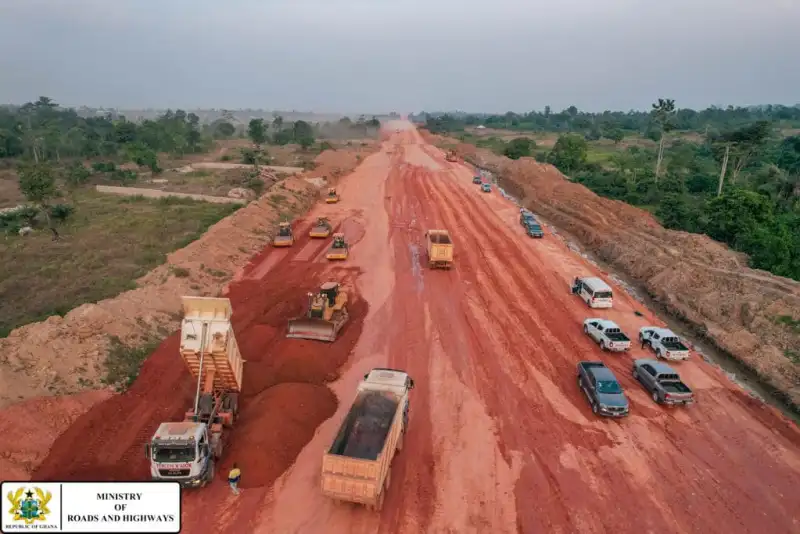
Ghana has taken a major step towards the construction of the Accra-Kumasi Expressway, after the Ghana Armed Forces officially handed over 175.6 kilometres of cleared right-of-way to the government on Monday, September 14, 2026.
The milestone moves one of Ghana’s biggest road infrastructure projects from planning closer to actual construction and is expected to transform travel between the country’s two largest cities.
The 198.7km Accra-Kumasi Expressway will pass through the Greater Accra, Eastern and Ashanti regions, providing a new high-capacity route designed to reduce travel time, improve road safety and lower the cost of transporting people and goods.
Accra-Kumasi Expressway at a glance
Project detail | Key information |
|---|---|
Total length | 198.7km |
Main route | Ablekuma to Sewua |
Regions covered | Greater Accra, Eastern and Ashanti |
New expressway construction | About 176km |
Connector roads | About 23km |
Road standard | Six-lane, bi-directional Class A expressway |
Design speed | 120km/h |
Mainline roadbed | 36 metres |
Interchanges | 8 grade-separated interchanges |
Mainline bridges | 55 |
Vehicle overpasses | 11 |
Box culverts | About 200 |
Full-service areas | 4 |
Tolling locations | 8 |
Right-of-way cleared | 175.6km |
Clearance period | 19 weeks |
Accra-Kumasi Expressway route: Where will it pass?
The new expressway will run for approximately 198.7 kilometres from Ablekuma in the Greater Accra Region to Sewua in the Ashanti Region.
The route will pass through three regions:
Greater Accra Region
Eastern Region
Ashanti Region
The project is expected to significantly shorten the current Accra-Kumasi journey. The existing route covers roughly 250 kilometres, while the new alignment will reduce the distance to about 198.7 kilometres.
That represents a reduction of more than 50 kilometres.
About 176 kilometres of the project will involve completely new expressway construction, while approximately 23 kilometres will comprise upgraded connector roads at the Accra and Kumasi ends.
Ghana's first six-lane Class A expressway
The Accra-Kumasi Expressway is being developed as Ghana's first modern six-lane, bi-directional Class A expressway.
According to Engineer Francisco, Managing Director of Accra-Kumasi Expressway Limited, the mainline will feature a three-lane dual carriageway built on a 36-metre standard roadbed.
The expressway has been designed for a maximum speed of 120 kilometres per hour, allowing long-distance traffic to move more efficiently between Accra and Kumasi.
The connector roads at both ends will have a lower Class B standard and a design speed of 60 kilometres per hour.
The difference in standards is intended to separate high-speed, long-distance traffic from slower urban traffic approaching Accra and Kumasi.
Accra-Kumasi Expressway interchanges
The project will feature eight grade-separated interchanges at strategic points along the route.
The planned interchange locations include areas serving:
Accra
Adeiso
Asamankese
Akyem Oda
Ofoase
Lake Bosomtwe
Kumasi
The interchanges will allow motorists to enter and exit the expressway while keeping through-traffic moving without the interruptions associated with conventional intersections.
Read morePatience Akyianu, former Barclays Bank Ghana MD and Hollard CEO, reportedly dies
Bridges, overpasses and drainage structures
The scale of the Accra-Kumasi Expressway goes beyond the main road itself.
The project includes:
55 mainline bridges
11 vehicle overpasses
Approximately 200 reinforced concrete box culverts
Nine at-grade intersections, mainly along the lower-speed connector sections
These structures will allow the expressway to cross rivers, streams and other challenging terrain while maintaining controlled access along the mainline.
Safety and emergency systems
Safety infrastructure has been incorporated into the project from the design stage.
The expressway will include a dedicated fire service and ambulance station, alongside three maintenance depots to support emergency response and road maintenance.
The road will also have safety systems linked to an intelligent transport system (ITS) with electromechanical installations.
Four full-service areas will be constructed along the corridor, providing motorists with locations to rest, refuel and deal with vehicle-related problems.
Eight tolling locations are also planned, supported by an operations centre and two monitoring centres responsible for traffic management and incident response.
Speaking about the expected safety improvements, Engineer Francisco said:
"When completed, this road will provide safer and more reliable transport and reduce the pressure on the N6."
How much time will the Accra-Kumasi Expressway save?
One of the main reasons for the project is to reduce the amount of time motorists spend travelling between Accra and Kumasi.
Officials are projecting a roughly 50% reduction in journey time once the expressway becomes operational.
The project is also expected to reduce transportation costs by about 40%.
The shorter alignment and higher-speed road will make it easier to move passengers, agricultural produce, manufactured goods and other freight between southern Ghana and the Ashanti Region and areas further north.
How the expressway could boost trade and logistics
The Accra-Kumasi corridor is one of Ghana's most important transport routes, linking the country's major commercial centres.
The new expressway is expected to improve the movement of goods between Accra, the Tema port area, Kumasi and markets across the middle and northern parts of Ghana.
A faster and more reliable road could also benefit logistics companies, manufacturers, traders and businesses operating along the corridor.
Read moreL.I. 2519: Full list of road traffic offences and jail terms in Ghana
Beyond transport, the government expects the project to stimulate economic activity and create employment in communities along the route.
The 2026 Budget estimated that the construction phase could generate more than 30,000 direct and indirect jobs.
Accra-Kumasi Expressway: Right-of-way cleared ahead of schedule
The Ghana Armed Forces, through the 48 Engineers Regiment, completed the right-of-way clearance in 19 weeks.
That was one week ahead of the government's original 20-week target.
A total of 175.6 kilometres of right-of-way was cleared before the formal handover to the government on September 14.
The cleared corridor stretches from Ablekuma to Sewua, covering major sections of the planned expressway alignment.
The completion of this phase is significant because right-of-way acquisition and clearance are among the major requirements before large-scale road construction can proceed.
When was the Accra-Kumasi Expressway announced?
The project was announced as a flagship infrastructure initiative in Ghana's 2026 Budget under the government's Big Push Infrastructure Programme.
It was presented as Ghana's first modern six-lane, bi-directional Class A expressway, with the 198.7-kilometre alignment already mapped out.
The September 14 right-of-way handover represents an important transition from government budget and planning announcements towards physical implementation.
President John Dramani Mahama has confirmed that an initial $2 billion is available to begin the project.
What happens next?
With the right-of-way clearance completed, attention now shifts towards the next stages of the project.
These include the construction of the main expressway, interchanges, bridges, connector roads, service areas, tolling infrastructure and safety systems.
If completed as planned, the Accra-Kumasi Expressway will provide Ghana with a modern, high-capacity transport corridor between its two largest cities.
The project is expected to shorten the distance between Accra and Kumasi, reduce journey times, improve road safety and lower transportation costs, while supporting trade, logistics and economic activity along the route.
Why the Accra-Kumasi Expressway matters
The project is more than an upgrade to an existing road. It is designed to fundamentally change how people and goods move between southern Ghana and the Ashanti Region.
With a 198.7km alignment, six lanes, eight interchanges, 55 bridges and extensive safety infrastructure, the expressway is set to become one of the most significant additions to Ghana's road network.
Edem Kwame
Chief Editor
Edem Kwame is a staff journalist at GH News Media, where he covers news, sports, politics and current affairs with a sharp focus on Ghanaian and African football.
More from Edem Kwame